

Your Power Partner
7FA Nozzle Repair: How Damage Impacts Flow Path, Heat Rate, and Reliability
7FA nozzle repair is not a routine maintenance line item. Stage 1 nozzles suffer oxidation, TBC spallation, trailing edge cracking, and cooling hole blockage during normal operation. Each damage mode degrades flow path efficiency, raises wheelspace temperatures, and increases heat rate by measurable BTU/kWh increments. Left unaddressed through an inspection interval, they accelerate downstream component degradation across the entire hot gas path. Allied Power Group’s GE Frame 7F gas turbine repair capabilities cover the full scope of what qualified 7FA nozzle work actually requires.
Key Takeaways
- Stage 1 nozzles are the highest-risk turbine component in the 7FA hot gas path — damage here produces the fastest and most measurable impact on heat rate and unit reliability.
- TBC spallation, trailing edge cracking, and cooling hole blockage are the three most common 7FA nozzle damage modes, each producing a distinct aerodynamic consequence in the gas path.
- The 7FA.04 variant uses GTD-111 directionally solidified superalloy with dense cooling hole geometry — this makes weld repair effectively impossible in most crack locations, fundamentally changing the repair strategy compared to the 7FA.03.
- A qualified repair process requires fluorescent penetrant inspection, dimensional scanning, approved weld or braze procedures, TBC recoat, cooling hole restoration, and a final flow test — visual inspection alone is not sufficient.
- Allied Power Group Technical Director Aaron Frost presented 7FA nozzle repair methodology at the Combustion Turbine Operators Task Force (CTOTF) conference — documented, conference-level expertise in this specific hardware platform.
Why the GE Frame 7FA Gas Turbine Creates a High-Stakes Repair Decision
GE’s 7FA gas turbine platform provides approximately 15 percent of North America’s electricity capacity — roughly 900 units across 350 sites globally, with more than 50 million cumulative fleet operating hours logged. At that scale, every repair decision carries disproportionate grid-level consequences.
The urgency is real and growing. A large percentage of the 7FA installed base came from the 1998 to 2001 construction bubble. Those units are now approaching rotor end-of-life thresholds outlined by the OEM: 144,000 Fired Factored Hours (FFH) or 5,000 Fired Factored Starts (FFS). At this lifecycle stage, nozzle condition is directly tied to rotor integrity decisions and major inspection timing. Missing or deferring a qualified nozzle repair at a hot gas path inspection can push damage into irreversible territory before the next major inspection window arrives.
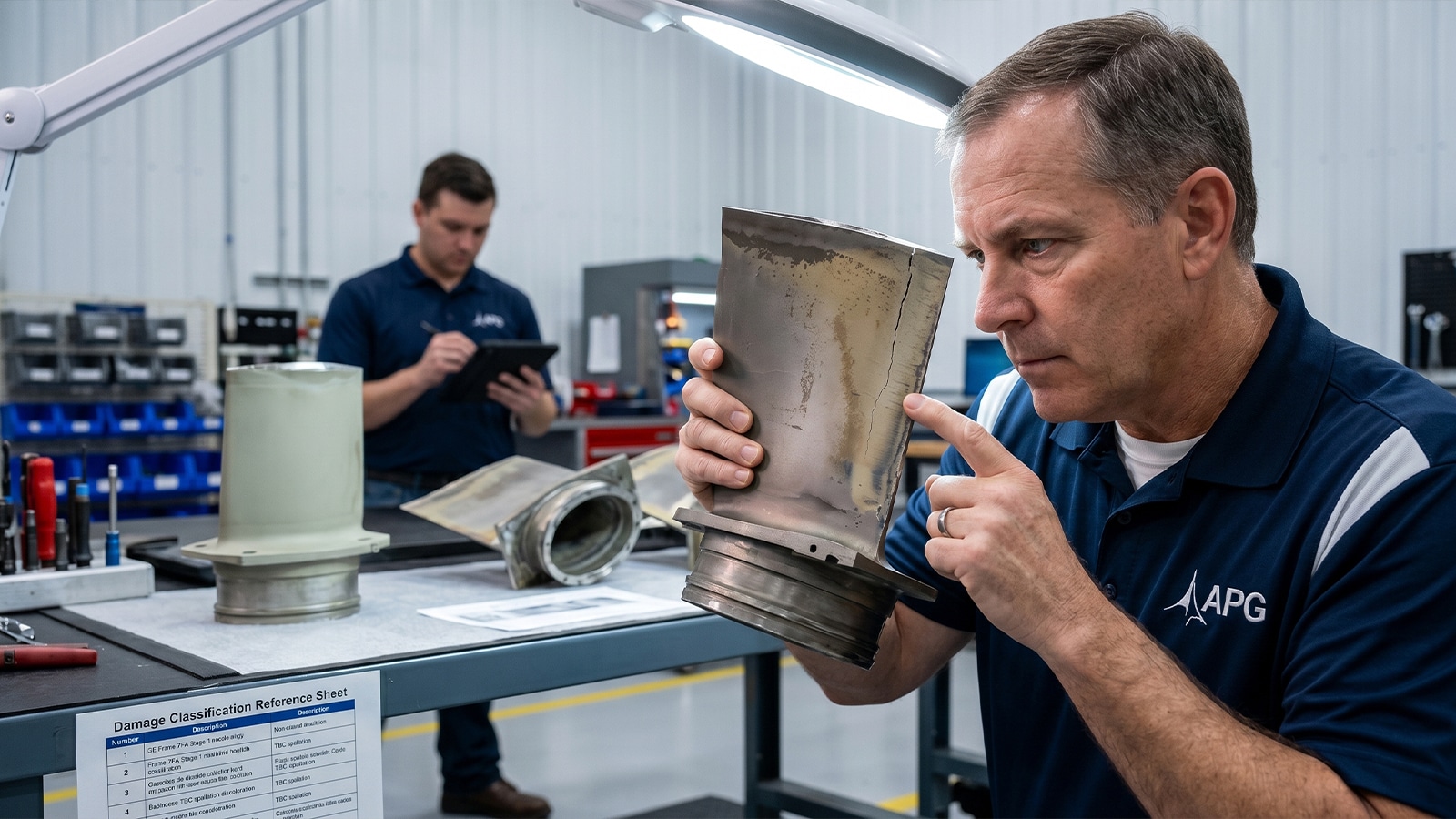
Stage-by-Stage Damage: What Actually Breaks on 7FA Nozzles and Why
Not all nozzle damage is created equal. Stage 1 damage is thermally driven and fast-moving. Stage 2 damage is slower but mechanically significant in ways that affect rotor clearances and long-term reliability.
Stage 1 Nozzle Damage Modes
Stage 1 nozzles receive combustion gases directly from the transition pieces at the highest temperature in the turbine. TBC spallation is the first failure mode to understand. The thermal barrier coating on Stage 1 airfoils is the primary defense against parent material oxidation. When the bond coat degrades through thermal cycling, the TBC delaminates and exposes the underlying alloy to direct combustion gas temperatures. Aaron Frost, Technical Director at Allied Power Group, observed at the CTOTF conference that on 7FA.03 hardware, an abundance of cracks appeared in locations where the OEM had not originally applied TBC — a finding that shapes the entire repair scope, because recoating those previously unprotected zones is as important as addressing the cracks themselves.
Trailing edge cracking is the most common structural damage mode on Stage 1 airfoils. The trailing edge is geometrically thin and carries the highest thermal gradient in the airfoil. Low-cycle fatigue from repeated start and stop cycles initiates cracks at this location with predictable regularity. Cooling hole blockage compounds TBC loss in a self-reinforcing cycle. Oxidation byproducts, coating migration, and debris from upstream hardware including transition pieces and flow sleeves partially or fully block film cooling holes over time. When those holes are blocked, the airfoil loses its primary mechanism for protecting the base metal, and TBC spallation and cooling hole blockage frequently co-locate, accelerating damage from two directions simultaneously.
Oxidation progresses steadily at the leading edge and pressure surface at high firing temperatures, reducing wall thickness and degrading the mechanical properties of the GTD-111 alloy substrate. Wall loss is rarely visible to the naked eye at early stages — dimensional scanning is required to detect it before it becomes structurally critical. Erosion from fine particulates abrades the airfoil surface progressively, altering geometry in ways only a dimensional scan can accurately characterize. Test results published by major gas turbine manufacturers confirm that rough airfoil finishes measurably increase heat rate compared to smooth, as-repaired surfaces.
Stage 2 Nozzle Damage Modes
Stage 2 nozzles operate at lower temperatures but experience higher mechanical stress from the expanded gas path downstream. Creep is the dominant damage mode — sustained high-temperature loading causes slow plastic deformation of the airfoil, concentrated at the shroud attachment and midspan sections. Unlike cracking, creep deformation may not trigger alarm conditions until it has already altered throat area geometry or rotor clearances. Erosion at Stage 2 tends to be more pronounced than at Stage 1 due to expanded gas velocity, and fatigue-driven cracking concentrates at stress concentration points within the shroud. Heat rate impact is less immediate than at Stage 1, but creep distortion affects mechanical dynamics and rotor clearances in ways that compound across successive inspection intervals.
How Nozzle Damage Distorts the Gas Path and Raises Heat Rate
Every damage mode produces a specific aerodynamic or thermodynamic outcome in the hot gas path, and those outcomes translate directly into the plant-level indicators engineers track: heat rate, output, and exhaust temperature.
Airfoil profile distortion from erosion, creep, or oxidation wall loss changes the nozzle throat area — the critical dimension controlling gas velocity entering the rotating buckets. A throat area deviation of even one to two percent from design geometry produces measurable stage efficiency loss. Multiply that across all nozzle segments in a stage and the aggregate heat rate impact becomes significant on the fuel cost statement. TBC spallation raises airfoil surface temperature, heats the gas flowing through the passage, and drives hot gas ingestion into the wheelspace, accelerating bucket shank and rotor disk degradation downstream. A coating failure on a single nozzle segment creates a damage vector that extends to rotating gas turbine blades and the rotor itself.
| Damage Mode | Flow Path Consequence | Plant-Level Indicator |
|---|---|---|
| TBC Spallation | Elevated airfoil surface temp; hot gas ingestion | Wheelspace temperature rise; accelerated bucket degradation |
| Trailing Edge Cracking | Aerodynamic leakage; reduced stage work output | Output reduction; heat rate increase |
| Cooling Hole Blockage | Reduced film cooling effectiveness | Airfoil metal temperature rise; shortened service interval |
| Oxidation and Wall Loss | Profile distortion; reduced structural integrity | Heat rate creep; unplanned failure risk |
| Creep at Stage 2 | Throat area deviation; rotor clearance distortion | Mechanical dynamics shift; long-cycle reliability risk |
| Erosion | Leading edge blunting; increased surface roughness | Stage efficiency loss; aerodynamic drag increase |
Elevated heat rate can trigger emissions permit compliance issues, capacity agreement penalties, and early trigger of the next inspection interval. Those financial consequences dwarf the cost of a properly executed nozzle repair.
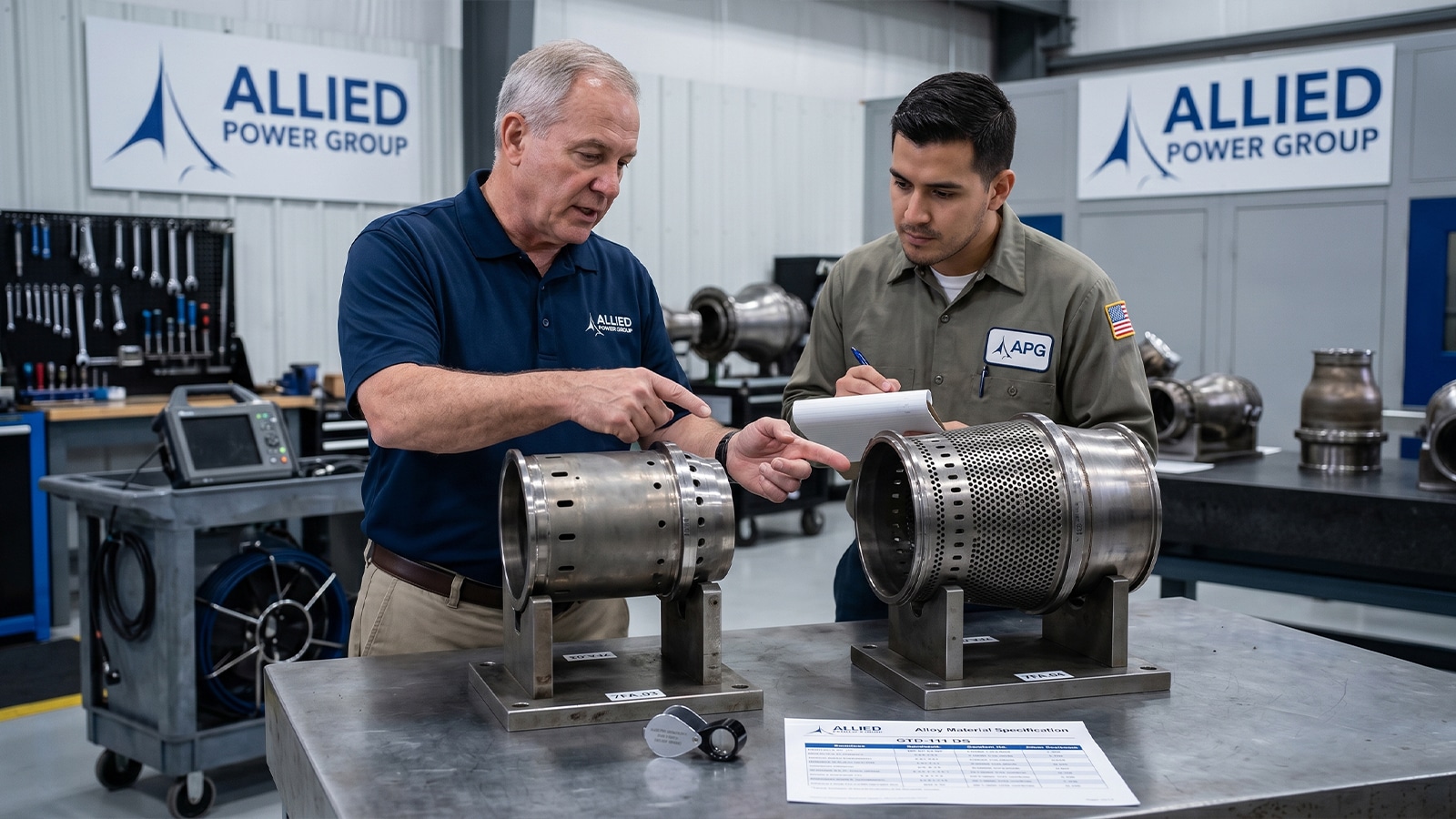
What Makes 7FA Nozzle Repair Different From Other Gas Turbine Repairs
The 7FA platform has two primary hardware variants in widespread service, and the repair approach is not interchangeable between them. The 7FA.03, previously designated the 7FA+e, is the variant on which weld repair is generally feasible in most crack locations. On 7FA.03 hardware with qualified procedures, a properly executed weld repair restores the base metal profile and resists re-cracking for many years of subsequent service.
The 7FA.04 is a different engineering challenge. This variant uses GTD-111 directionally solidified superalloy in a configuration with more cooling holes and tighter airfoil geometry. As Frost specifically warned at CTOTF, the GTD-111 alloy in this form is essentially unweldable in most nozzle crack locations. The high gamma-prime content of this nickel-based alloy makes it susceptible to strain-age cracking during welding, and the dense cooling hole layout leaves insufficient base metal for a structural weld repair in most areas. That constraint forces the repair shop toward braze repair in many 7FA.04 crack scenarios. Braze is a life-limited fix — cracks reappear relatively quickly after a braze repair, and the braze chemistry can initiate further cracking in surrounding material. Aerospace alloys used in standard braze formulations do not always translate to industrial turbine service because the thermal cycle demands differ from what those alloys were originally designed to handle.
A repair vendor applying the same procedure to both variants without differentiation has already signaled insufficient experience with this hardware.
Weld Repair vs. Braze Repair on the 7FA: Why the Decision Matters
The weld-versus-braze question is the single most commercially significant decision in the 7FA nozzle repair scope — and the area where cost pressure most frequently produces bad outcomes. A weld repair performed with an approved filler alloy such as Mar-M-918 Modified, with the correct pre-heat and post-weld heat treatment sequence, holds up through multiple inspection intervals without recurring damage at the repair site. A braze repair using a low-melting-point filler compound blended into a parent metal powder does not match that durability.
The cost-effective choice is weld repair where the alloy condition and geometry allow it. But that choice requires a shop with qualified procedures, the correct weld filler inventory, and welder certifications specific to GTD-111 and its derivatives. Braze repair has a legitimate role in specific crack configurations — it should be the engineer’s deliberate choice based on technical merit, not the default because weld repair is harder to execute.
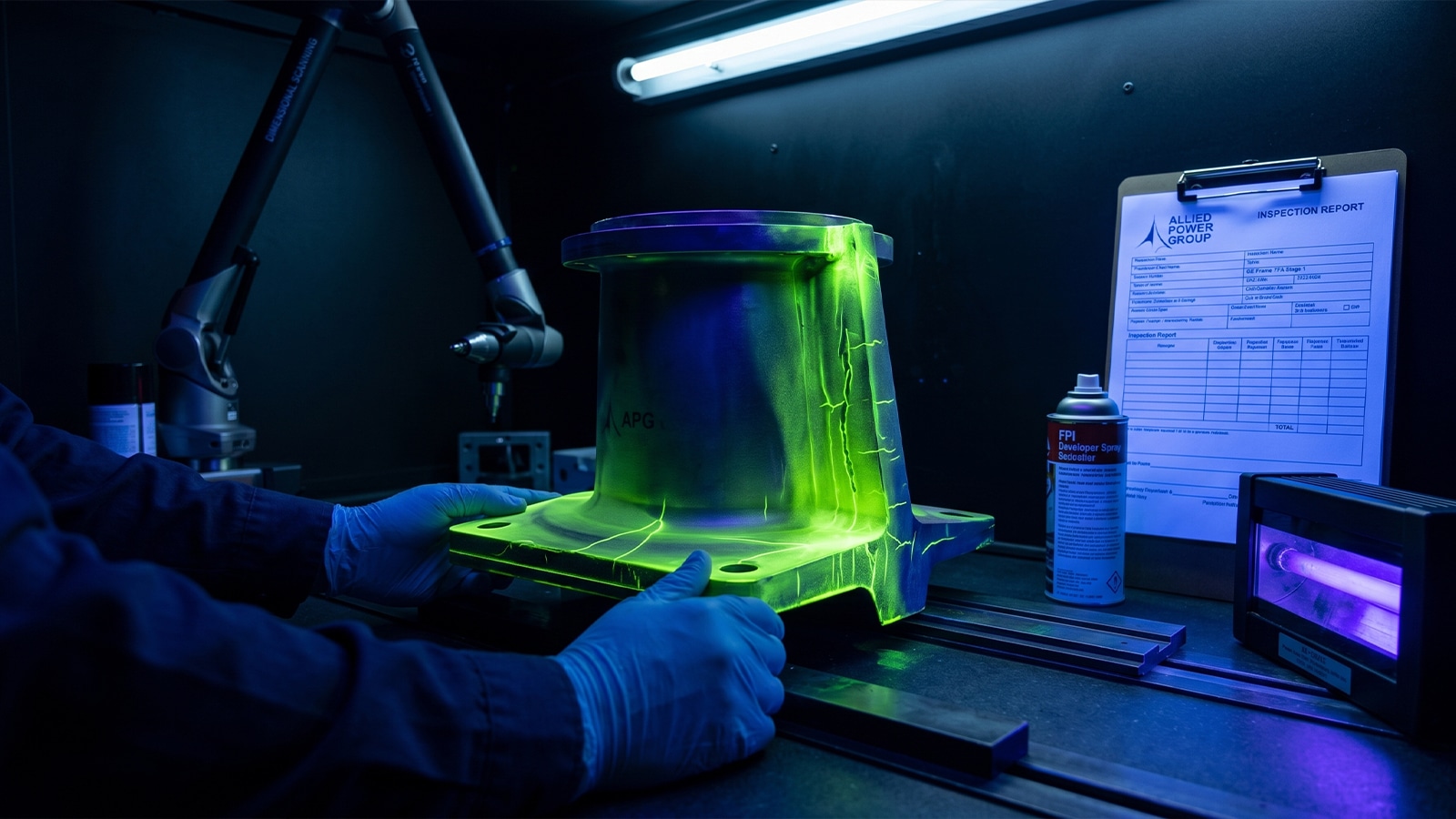
The 7FA Nozzle Inspection Process: What It Must Include
Pricing pressure in the turbine component repair market has created incentives for some providers to shortcut the inspection sequence, relying on visual assessment where NDE is required. A shop that only conducts a visual inspect of nozzle airfoils will catch visible surface cracking and obvious TBC loss. It will not detect subsurface crack propagation, wall thinning from internal oxidation, or geometry deviation from creep distortion — the damage modes most likely to produce failure in the next service interval.
A complete inspection sequence for 7FA nozzle hardware follows this structure: receive-and-document, covering each segment against prior inspection records and operating history; fluorescent penetrant inspection after coating strip, because residual TBC or bond coat masks crack indications and produces false-clear results; white light scanning to capture airfoil geometry with the point-cloud accuracy required to evaluate throat area, pitch deviation, and leading edge profile against design tolerances; metallurgical evaluation of representative material samples when base metal condition is uncertain, particularly on hardware that has accumulated significant FFH or experienced an overtemperature event; and ultrasonic testing to detect sub-surface damage where surface-penetrant methods cannot reach.
A dimensional scan at the pre-repair stage establishes the geometry baseline against which dimensional restoration will be verified at process close. Without white light scanning, dimensional data is incomplete. Engineers reviewing a repair proposal should ask explicitly whether it is included as a standard deliverable.
The 7FA Nozzle Repair Process Step by Step
What a Qualified Repair Process Covers From Strip to Final Inspection
A qualified provider executes the following defined repair process for 7FA nozzle hardware, with each turbine component tracked individually through the full repair cycle.
- Receive and document: segment identity, damage catalogue, operating history review.
- Coating strip: remove existing thermal barrier coating and bond coat by chemical or thermal method appropriate to substrate condition, without introducing mechanical damage to the airfoil surface.
- Post-strip NDE: full FPI and ultrasonic testing on bare metal to establish the true damage map.
- Dimensional scan: pre-repair geometry baseline captured by white light scan for comparison at process close.
- Base metal repair: oxidation-driven wall loss, crack preparation, and weld repair where alloy condition and geometry permit. Where weld is not viable, braze repair is executed with a filler selected for the actual industrial thermal cycle — not a generic aerospace braze compound applied without consideration of duty requirements.
- Cooling hole restoration: each film cooling hole returned to design diameter and geometry, using tooling sized to the specific hole pattern for the variant being repaired. 7FA.03 and 7FA.04 cooling hole geometry are not identical.
- Bond coat and TBC recoat: approved spray process matched to the original coating system’s thermal conductivity and adhesion characteristics. Thermal barrier coating applied robotically to controlled thickness — a thin, adherent TBC that stays on is more effective than a thick or manually applied coating that spalls early.
- Final NDE and dimensional verification: confirm all repair work meets dimensional tolerance requirements and surface condition standards.
- Flow test: each segment tested at a calibrated flow rig to confirm cooling hole restoration has returned the segment to design flow characteristics. A repaired blade without a flow test result is a blade whose cooling performance has not been confirmed.
This repair process reflects documented repair procedures executed by qualified providers with certified technicians and inspection data behind every decision. It is the baseline against which any repair proposal should be evaluated.
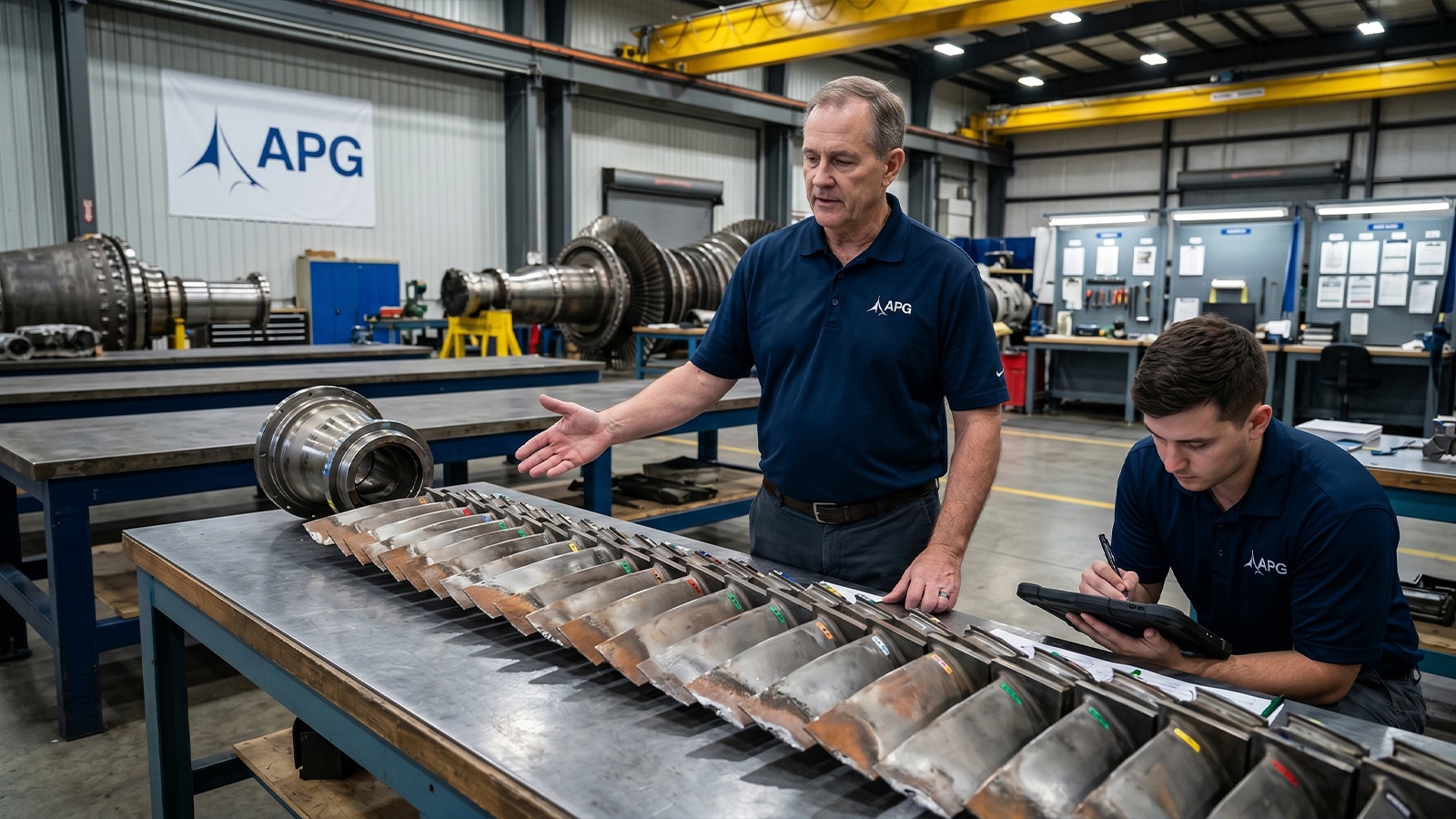
What Gas Turbine Blades and Downstream Turbine Parts Experience When Nozzles Are Not Properly Repaired
Nozzle damage does not stay contained to the nozzle. When a Stage 1 nozzle segment fails to maintain design geometry, throat area distortion alters the gas velocity and pressure entering the downstream rotating buckets. When TBC spallation raises nozzle surface temperatures, the wheelspace temperature rise that follows degrades bucket shank coatings, blade tip clearances, and the abrasion resistance of shroud interfaces. When cooling hole blockage goes undetected, the airfoil metal temperature rise propagates heat into the gas stream that rotating components — turbine blades, shroud tiles, and rotor disks — were not designed to absorb continuously.
A case study from Allied Power Group’s 7FA service history illustrates this chain directly: units presenting with elevated Stage 1 wheelspace temperatures on initial consultation were found on inspection to have nozzle segments with combined TBC spallation and cooling hole blockage concentrated at the same airfoil location — damage that had been present across at least one prior inspection interval without triggering a nozzle-focused repair scope. The downstream consequence was accelerated blade repair scope on the first-stage buckets and measurable rotor disk oxidation at the wheelspace interface. Component repair costs on the buckets exceeded what a timely nozzle repair would have cost by a factor of several. The economic argument for proactive nozzle repair scope is not abstract when downstream turbine component damage is the counterfactual.
Allied Power Group has developed and refined repair solutions for GE 7F assets since 2005, with a track record of zero failures across more than 1,500 repaired part sets.
FAQ
Can 7FA nozzles made from GTD-111 be welded?
On 7FA.03 hardware, weld repair is feasible at most crack locations when performed with approved procedures, correct pre-heat, and post-weld heat treatment using a qualified filler such as Mar-M-918 Modified. On the 7FA.04, the combination of GTD-111’s high gamma-prime content and the dense cooling hole geometry makes weld repair effectively impossible in most crack locations — braze repair is the practical alternative in those cases, with the understanding that it is a less durable fix.
How does nozzle damage affect heat rate in a 7FA gas turbine?
Nozzle damage degrades heat rate through two channels: aerodynamic efficiency loss from throat area distortion and surface roughness from erosion, and thermal management failure from TBC spallation that raises gas path temperatures and increases cooling requirements. Even a one to two percent throat area deviation from design geometry produces measurable stage efficiency loss when applied across all segments in the stage.
What is the difference between a weld repair and a braze repair on a 7FA nozzle?
Weld repair, executed with an approved filler alloy and full heat treatment, restores the base metal profile and holds through multiple inspection intervals. Braze repair uses a low-melting-point filler to fill cracks without full structural reintegration — it is faster and less expensive but allows cracks to reappear sooner and can initiate additional cracking in surrounding material if the braze chemistry is not matched to the industrial thermal cycle.
How often should 7FA nozzles be inspected?
The standard GE-recommended cadence for hot gas path inspections is approximately 24,000 FFH or 900 FFS, though actual intervals depend on operating mode, fuel type, and peak firing temperature. Early inspection is warranted when heat rate creep above baseline, elevated Stage 1 wheelspace temperatures, or unexplained output reduction is observed, or when combustion inspection of transition pieces or flow sleeves reveals upstream hardware damage that may have introduced debris into the gas path.
What inspection methods are required for a complete 7FA nozzle assessment?
A complete nozzle inspection requires fluorescent penetrant inspection on stripped airfoil surfaces, white light dimensional scanning for geometry and throat area verification against design tolerances, metallurgical evaluation when base metal condition or overtemperature history is uncertain, and ultrasonic testing for sub-surface damage detection. Visual inspection alone is not sufficient and should not be accepted as a complete assessment from any repair provider.